
What really goes into delivering safe, reliable traffic management.
Posted on 12th July 2026 by Grace Goodall
3 minutes read time
- What does a Technical Officer do at NTS?
- What information do you need to book a traffic management job?
- What does a traffic management survey involve?
- What standards and guidance do you follow to ensure compliance?
- How is traffic management plan developed with the CAD team?
- Does a Technical Officer stay involved once the survey is done?
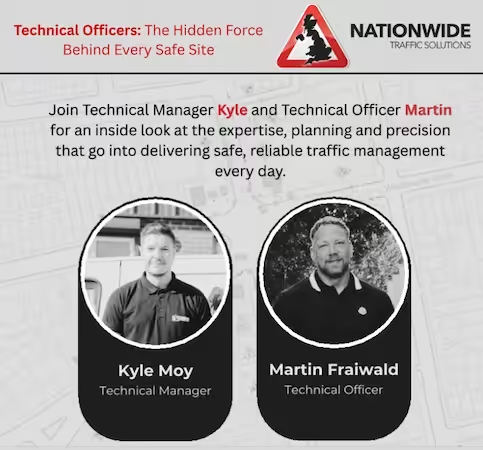
We sat down with Technical Manager Kyle Moy and Technical Officer Martin Fraiwald to find out what really goes into delivering safe, reliable traffic management. From site surveys to compliance to working with our CAD team.
What does a Technical Officer do at NTS?
At NTS, the Technical Officer is central to how project comes together, developing the plans and practical solutions that ensure work is delivered safely, efficiently and in line with the client needs.
It’s about making sure everything works both on paper and on site – considering the safety of the workforce, road users and pedestrians from the outset.
The role is varied, involving close collaboration with the wider team, regular client interaction, and the time spend on site to bring plans to life. It’s a hands-on position that combines technical expertise with real-world insight to deliver smooth, reliable traffic management solutions.
What information do you need to book a traffic management job?
We need a clear picture of the job from the outset – where the works are, what’s being carried out, how long they’ll be in place, and what’s the road environment looks like.
That last point is particularly important, as no two sites are the same. Traffic management in a busy urban setting requires a very different approach to a high-speed rural or dual carriageway, so the solution always needs to be tailored to the conditions.
Once we have that understanding, we can put together the most suitable plan and highlight any potential issues early on – because the earlier something is identified, the easier and more cost-effective it is to resolve.
What does a traffic management survey involve?
It starts with getting a thorough understanding of the site – visiting in person, speaking with those involved, and building a clear picture of the environment. It’s about taking real ownership of the recommendations we make and ensuring they’re right for the location.
We’ll also use tools like Street View to sense-check details such as road widths, visibility and junction layouts, but that always supports – not replaces – what we see on site.
Ultimately, the survey is where we lay the groundwork, for a successful project. It’s our opportunity to identify the right approach from the outset and address any potential issues early, helping to ensure everything runs smoothly once work begins.
What standards and guidance do you follow to ensure compliance?
There’s a solid framework behind every compliant design. We follow Chapter 8 of the Traffic Signs Manual, the Traffic Signs Regulations and General Directions and the Safety at Street Works, and Road Works Code of Practice, along with other relevant standards depending on the site.
Qualifications such as LANTRA provide the foundation, but it’s a real-world experience that really brings it to life, Every site is different, so it’s about applying the guidance correctly in practice rather than just following it on paper.
Ultimately, compliance is about making sure the design is safe, practical, and works in the real world.
How is traffic management plan developed with the CAD team?
It’s a very close working relationship, as we’re all part of the same technical team – nothing is just handled over and left. The CAD team’s drawings are a key part of the process, as they’re submitted to councils and other approving bodies before anything foes out on site, and then used by operatives to set everything out correctly on the ground.
Because of that, accuracy is critical. We work together throughout to make sure the final plan reflects the clients requirements, the realities of the site, and any permit conditions. Ultimately, it has to be right first time.
Does a Technical Officer stay involved once the survey is done?
Very much so – the involvement doesn’t stop once the survey is complete. Technical Officers stay engaged throughout the whole process, working closely with project administrations to make sure planning and delivery stay aligned.
We’re also a direct point of contact for clients, so if questions come up around the traffic management at any stage, we’re on hand to support.
On site, if the crew need clarification or something changes, we’re there to help quickly – whether that’s talking through a decision or turning around a revised drawing. The survey is really just the starting point.